Film review / Alejandro G. Iñárritu
Digger
Alejandro G. Iñárritu turns climate catastrophe into a hall of mirrors, asking what satire can do when reality has already learned to parody itself.
Spoiler warning: This review discusses major plot developments and the ending.

A man helps wreck the planet and decides that what humanity needs now is more of him. That is Digger Rockwell’s solution to the catastrophe in Alejandro G. Iñárritu’s Digger, and Tom Cruise sells it with the terrifying confidence of someone who thinks being listened to has always meant being right. He is appalling. He is also very funny, and Iñárritu lets us enjoy his company long enough for that enjoyment to become a problem. What happens after we have laughed at the man responsible for everything? This extraordinary film makes the question harder to put aside with every return to its outrageous protagonist.
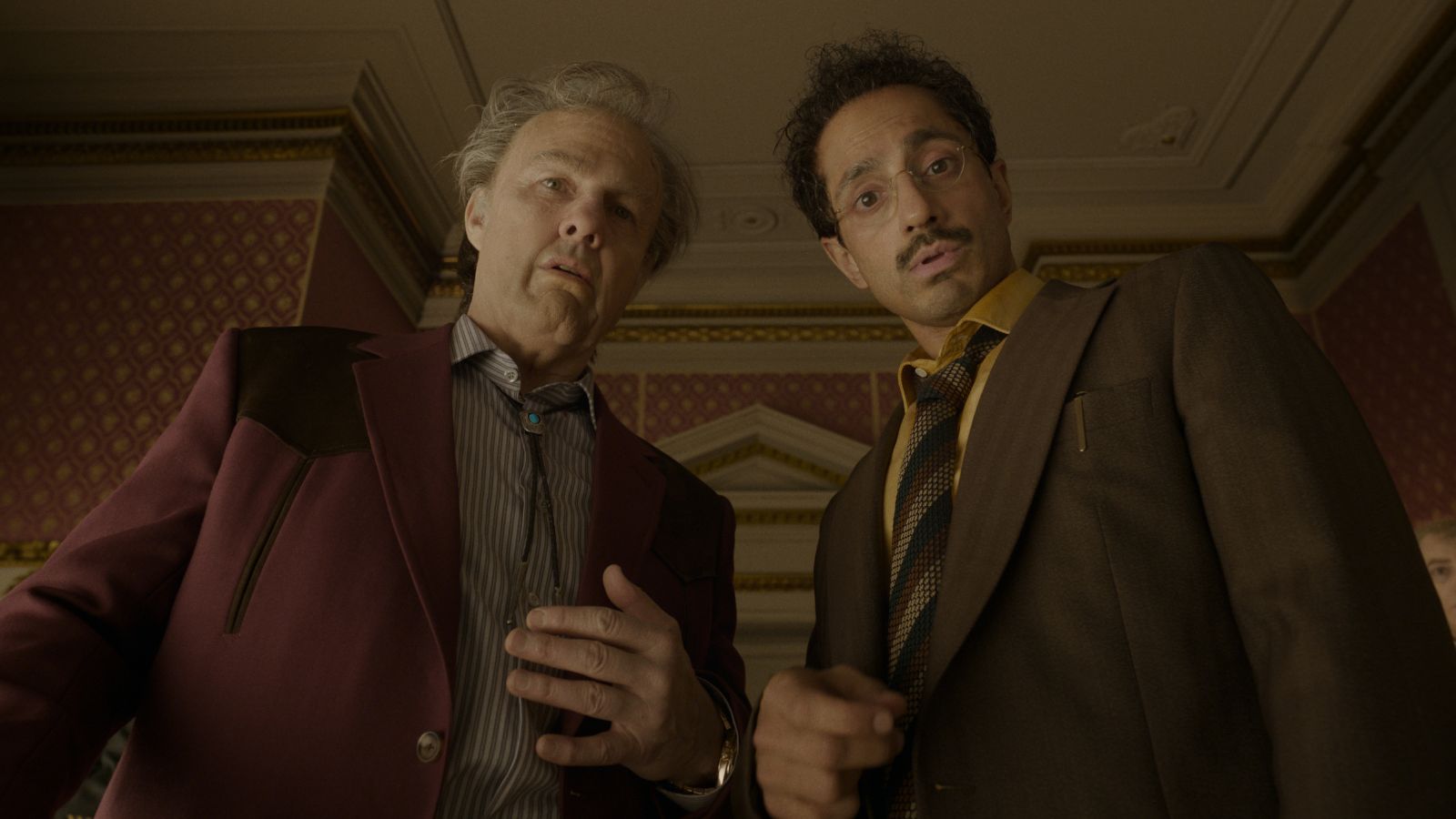
Rockwell is an American oil billionaire whose drilling operations have set an environmental disaster in motion. A vast ice shelf threatens catastrophic flooding, while the people equipped to understand the danger struggle to make themselves heard. Dr. Ganesh (Riz Ahmed), the scientist in Digger’s orbit, brings unwelcome information to men accustomed to getting more agreeable answers. President Compson (John Goodman) involves Digger in the response, giving the man who helped cause the emergency another opportunity to imagine himself indispensable. The scale is apocalyptic; the habits are depressingly familiar. Money, influence, and personal vanity continue organizing the conversation long after the planet has stopped cooperating.
Cruise makes that refusal to adjust enormously watchable. Digger has an opinion about everything and a seemingly inexhaustible supply of confidence with which to deliver it. The exaggeration is part of the pleasure: here is a man whose self-importance has become so extravagant that it can almost pass for a form of conviction. Iñárritu allows him to dominate our attention. Before the film starts asking what it means to turn someone like this into entertainment, it makes certain we have experienced the attraction.
Then a tree topples outside Digger’s window, and a stagehand appears to set it upright. The world we have been watching is a theatrical production, and Cruise is playing Curtis Markson, the actor portraying Rockwell in a play called Fossil Fools. Staged decades after the catastrophe, the play turns events from this world’s history into an elaborate political farce. The film moves between the production and the people mounting it, while the destruction they are reenacting continues to shape their lives outside the theater. That distinction changes the stakes of every broad gesture. These performers are making jokes about a disaster their audience has inherited.
What I love about this reveal is how little interest Iñárritu has in using it to excuse or discard the film we have already been watching. We keep returning to Fossil Fools. Its excesses remain available for us to enjoy, resist, or find exhausting. Some of the comedy is incredibly broad, and some jokes land harder than others. Knowing that we are watching a play does not make every joke better. It does, however, give the unevenness somewhere to go: into Curtis’s doubts about the performance, and into our own uncertainty about what we are getting from it.
Those doubts have an urgent personal context. Curtis is trying to find out whether his daughter is safe after her flight is endangered by a hurricane. His disagreement with the production’s director about the treatment of suffering therefore reaches well beyond an actor’s vanity. He has to keep turning catastrophe into an evening’s entertainment while waiting to learn whether catastrophe has taken someone he loves. The film’s movement backstage acquires a painful immediacy. The distance that makes a disaster available for comedy is a distance Curtis can no longer reliably maintain.
That is also why the amount of time spent inside Fossil Fools works for me. A brief excerpt followed by a discussion of its shortcomings would leave us judging the production largely on Curtis’s authority. Instead, Iñárritu makes us sit with it. We have developed an appetite for Cruise’s performance before the actor playing the role starts questioning what that appetite is serving. The repetition puts pressure on our enjoyment. I can understand why it might wear some viewers down; for me, the experience of being drawn back into the play is essential to the argument.
Digger’s enormous monologue shows how sharp that argument can become. He begins with an accusation that is uncomfortably difficult to dismiss: the people condemning him also participate in the system that has enriched him. They consume its products, benefit from its conveniences, and then want a single villain onto whom they can transfer responsibility. For a moment, he almost has a point. Then he converts that shared involvement into a defense of his own power. If everybody is implicated, who gets to hold him accountable? How convenient that his diagnosis of the problem should leave him in charge of the solution.
Cruise is phenomenal at sustaining the danger in that maneuver. Digger has to be persuasive enough for his self-justification to feel briefly tempting. The scene allows an argument to approach the truth and then watches its speaker use that proximity to protect himself. His grotesquerie does not make him harmless. It can even make him easier to listen to, because we have already decided we know what sort of ridiculous man he is. The pleasure of the performance becomes one of the things the film asks us to examine.
The problem gets stranger when reality already seems to have written the caricature. A billionaire presents his own destructiveness as proof that only he can save us; politicians handle catastrophe as though influence and a reassuring performance might make it negotiable. It is hard to exaggerate a ruling class that so enthusiastically exaggerates itself. The film’s broadness has to compete with behavior we have already learned to accept as ordinary. That makes its question about satire more urgent to me. An audience may already recognize every absurdity and still feel powerless to change the conditions that allow it. The joke can be accurate, merciless, even brilliantly performed, and leave intact the arrangements that made its subject powerful.
Cruise’s screen history gives the performance another charge. Few actors have spent so much of their careers making impossible individual agency feel reassuring: another obstacle cleared, another physical limit exceeded, another disaster narrowly averted. Digger puts that confidence in the service of a man who helped create the disaster in the first place. Curtis, meanwhile, faces the far less glamorous experience of being unable to control what is happening to his daughter. Cruise holds both men in the same performance. The grandiosity onstage and the anxiety around it keep changing the meaning of one another.
Kenny Rockwell (Jesse Plemons), the producer financing Fossil Fools, complicates the question further when he reveals that he is Digger’s nephew. The boy who appears in the play is a representation of his younger self. What Curtis is struggling to perform includes Kenny’s childhood, and the man being turned into a public grotesque is his uncle. Kenny defends the production as a place for audiences to express their anger and find relief in seeing Digger brought low. His connection to that history gives the defense weight. His position as the person paying to stage it also makes it worth scrutinizing.
This gives Kenny’s presence in the audience a significance the film has carefully earned. He is watching his family’s history become entertainment, having helped make that entertainment possible. Around him, the spectators refuse to supply a single, convenient verdict. They laugh, cheer, boo, applaud, and cry. The same performance has produced responses that cannot be gathered neatly under the heading of success. Some people may recognize their own anger; others may take pleasure in the humiliation of a man they blame. The film lets those reactions exist beside one another without pretending that emotional intensity proves the play has accomplished everything its makers hoped.
For me, that is where Digger becomes much more interesting than a satire concerned only with identifying its target. Ridicule can puncture a powerful person’s authority, but it can also make that person familiar, entertaining, even oddly welcome. We return because the performance gives us pleasure. Fossil Fools understands that pleasure well enough to draw a crowd, while Curtis worries about what gets lost in providing it. Kenny offers a defense of its usefulness. The audience demonstrates that neither man can completely determine what the work will mean once it reaches other people.
Iñárritu gives these competing claims a film large and beautiful enough to implicate itself. Emmanuel Lubezki’s VistaVision photography and the elaborate production design by Dennis Gassner and Richard Johnson make the spectacle inviting even after its theatrical construction has been exposed. Recognizing a room as a set does not cancel the pleasure of looking at it. The same is true of Cruise’s performance: understanding its layers only gives us more to watch. Iñárritu keeps making the very thing his film is questioning, and that willingness to remain entangled in the problem is part of what I find so exhilarating about it.
The ending gives this argument its most sobering image. After the performance, the spectators put on respirators and return to a city still scarred by flooding. The catastrophe that has become a story inside the theater remains a condition of life outside it. Their responses may have been sincere and deeply felt; the damage does not disappear with the applause. That makes the question I keep returning to painfully concrete: what can art actually change? A room full of people can recognize who failed them and still leave without a shared idea of what to do next. Their grief and laughter are real. So is the possibility that the evening has made an intolerable world a little easier to tolerate.
Yet judging the play solely by whether it changes that world would miss something the film makes impossible for me to dismiss. Watching this history together gives the spectators a way to remember, to mourn, and to recognize feelings they may be unable to express alone. Laughter can be a form of grief as well as an escape from it. There is a distinction between giving suffering a shape people can share and selling them another manageable evening of it, but Digger will not let us draw that distinction with complete confidence. The same performance can offer remembrance, criticism, release, and another thing to consume. Those possibilities can coexist in the same room, even in the same person.
I think Digger is a masterpiece because it stays with that difficulty instead of treating it as grounds to give up. Curtis can question the value of his performance and still return to it. An audience can find recognition, anger, or relief in a work that cannot repair what happened. Iñárritu offers all the exhilaration of an enormous cinematic spectacle while asking us to account for the pleasures we have taken from it. I came away thrilled by Cruise, moved by the persistence of the people making and watching this play, and unable to separate that enthusiasm from the questions the film had raised. The more I sit with it, the more I want to return.

Joshua Relyea
Founder and editor of Relyea on Film. Writing about new releases, international cinema, and the films worth returning to.